Are supplements tested? What a label cannot tell you.
A man took a product marketed as a dietary supplement for two years. It contained testosterone instead of the compound on the label. Every safeguard that might have caught it begins by reading that label.
A pharmacist checking whether a supplement collides with your prescriptions picks the tub up and turns it over. So does your GP. So does our own interactions checker. All three are reading the same list printed on the back, and not one of them can tell you whether it is true.
In August 2026 the BBC reported the case of Daniel Murphy, a 32-year-old from Knoxville, Tennessee, who had lost 59kg through diet and exercise. He bought what he believed was a tested dietary supplement to help him build some muscle back. Over the next two years his sleep went, then his judgement. A consultant psychiatrist gave evidence in the court proceedings, the BBC reports, that he believed Murphy had been suffering a steroid-induced psychosis. It led him, in his word, to "burn down" what he had built: his marriage, his friendships, his business.
He stopped in December 2024, when his supply ran out. He was told what he had actually been taking in February 2025, and says he now seems to have made a full recovery.
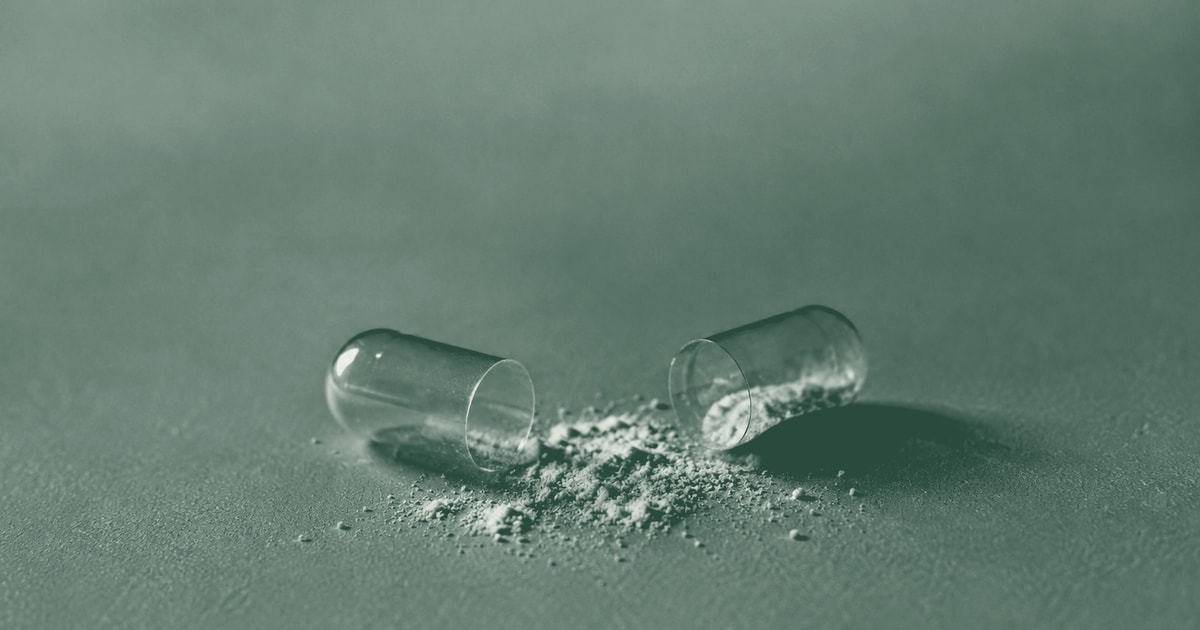
The daily pills contained testosterone. Nobody at the company had tested a batch to find out. The company had, however, told its customers in writing that it tested everything.
When the label is fiction, every check anyone runs is a careful answer to a question about a product that does not exist.
Are supplements tested before they go on sale?
In the UK, not in the way medicines are. Food supplements are regulated as a category of food rather than as medicines. The NHS Specialist Pharmacy Service, the NHS's own medicines advice service, puts the consequence plainly: food manufacturers "are not required to prove the safety or efficacy of their products before placing them on the market". A medicine cannot be sold until the MHRA grants it a licence. A supplement can be sold without anyone proving in advance that it works or that it is safe.
The same guidance goes further, and describes Murphy's case in the abstract years before anyone had heard of it. Supplements "are not required to be manufactured to the more stringent standards of medicines", so "there may be significant variations in quantity of ingredients between batches and within the same batch. Undeclared ingredients may also be present."
That is not a campaign group. That is the NHS telling prescribers that what is in the bottle may not be what is on the bottle. It describes what the rules permit rather than how often it happens.
A claim nobody can check costs nothing to make
Saying a thing had been tested was cheaper than testing it, and nobody outside the company could tell the difference.
Murphy bought from Paradigm Peptides, a US company selling products described as SARMs, a class of experimental muscle-building compounds. The products were packaged and marketed as dietary supplements. The Department of Justice sets out what the company told people. It said it was licensed and registered with the FDA. It said it manufactured its products at its own laboratories in the United States. It said it tested those products to ensure the highest quality. In the department's account each of those was false: the products were imported from Asia, including China and India, and were not tested for quality before being sold. Its owner, Matthew Kawa, and his sister Jennifer Stechkober pleaded guilty to introducing unapproved new drugs into interstate commerce with the intent to defraud and mislead, and Kawa additionally to illegally importing merchandise.
Two of the admissions matter more than the rest. Kawa admitted the company had forged laboratory certificates, the documents that are supposed to prove a batch is what it claims to be, and he admitted knowing the products were being sold for people to swallow while the site described them as for research only. The FDA had also written to him in 2020 and 2022, warning that he was marketing and selling unapproved drugs. Prosecutors did not say he knew there was testosterone in the capsules. The Department of Justice records that many of the SARMs the company sold were in fact testosterone rather than the compound named on the label. Kawa was sentenced to 70 months in prison and Stechkober to 16 months, the judge finding that she had played an integral role but was not the mastermind. More than 54,000 customers across all fifty US states and more than eighty countries had bought from the company between April 2019 and March 2024.
This was not a manufacturing accident, and not a contaminant creeping in at the edges of a careful process. It was a sentence on a website saying testing had happened, and no buyer anywhere had a way to check.
The claim would have cost the same to make if it had been true.
That is the part that reaches past this one company. Testing a batch costs money and saying you tested it costs nothing, and absent a third-party mark, on a shelf the two look identical. A company that pays for the testing carries a cost its competitor does not.
Was this one bad company, or a pattern?
It is a documented pattern. It also concentrates in specific product categories rather than spreading evenly across the shelf.
An analysis in JAMA Network Open catalogued every dietary supplement the US FDA had warned about for containing undeclared, unapproved pharmaceutical ingredients between 2007 and 2016. There were 776 of them, from 146 different companies. Three categories accounted for almost all of them: sexual enhancement, weight loss, muscle building. Within that last group, 82 of the 92 flagged products, 89.1%, contained synthetic steroids or steroid-like ingredients (Tucker 2018, PMID 30646238).
That figure is easy to misread in an alarming direction. It is not 89% of every product in that category. It is 89% of the ones the FDA had already warned about, a list assembled precisely because something was wrong with them. What the number tells you is what the hidden ingredient tends to be once a product in that category goes wrong. The answer is a steroid.
The useful signal is the category split. Undeclared drugs cluster in the products promising the sort of effect a prescription delivers: get hard, get thin, get big. That is a long way from where a vitamin D3 capsule sits. Implying otherwise would be its own kind of dishonesty.
Does third-party testing protect you?
It reduces the risk in a way a label cannot, but it does not remove it.
Certification schemes do the one thing a label is incapable of doing: somebody opens a bottle from the actual batch you might buy and measures what is inside it. Informed Sport, run by the laboratory group LGC in the UK, is the best known. Every batch is tested individually before release rather than pooled with others, screening for more than 285 substances prohibited in sport. The classes it screens for include anabolic agents and SARMs.
Certification of that kind lowers the chance of an undeclared anabolic agent in a given batch, but what you are buying is a reduced risk rather than a guarantee. The scheme states that ceiling in its own FAQ: "no supplement testing programme can test for all substances which would be considered prohibited in sport". There is also a limit no laboratory can close from the outside. A company willing to forge its certificates is not going to volunteer its adulterated batch for independent analysis.
A batch certificate also does not tell you the product works, and it is not primarily a check that the dose on the front of the bottle is the dose in the capsule. It answers one narrow question properly, which is considerably more than a marketing claim does.
What can an interactions checker not protect you from?
From an undeclared ingredient. We build one, so we should say that plainly.
Our free interactions checker asks you for a supplement and a medication and tells you what we have assessed for that pair. Our questionnaire asks people to list what they are already taking. Both of those are reasoning about a name. Type in ashwagandha and we will tell you what we have on ashwagandha, including where we have nothing. Neither the checker nor the report, nor any other interaction tool, has a way of knowing whether the capsule in your hand contains ashwagandha at all, because all of them work from the ingredients a label declares.
That blind spot is not ours alone, and it is not something we could fix by being cleverer about the evidence. It belongs to every interaction database built on declared ingredients, a pharmacist's and a GP's included, because that is what all of them are indexed on. An undeclared ingredient is by definition missing from the index.
Which is why the sourcing guidance in a Distil report is deliberately not a list of products or retailers. We do not sell supplements, take commission, or stock anything, so we earn nothing whichever product anyone buys. What we can usefully point at are the two things on a label that are checkable: the specific chemical form of the compound, and whether an independent laboratory has tested the batch.
What to check before you buy
Four things, in descending order of how much they tell you.
Does the category promise the effect of a drug? This is the strongest single filter and it costs nothing. The adulterated categories in the FDA data are the ones selling an outcome a prescription would normally deliver. A product promising rapid fat loss, an erection, or the sort of muscle gain steroids produce sits in the population where undeclared drugs genuinely turn up.
Is it a supplement at all? SARMs and research peptides are not supplements, whatever a label says. Anything sold "for research use only" is telling you it has not been assessed for a person to swallow. UK Anti-Doping is blunt about it: SARMs are experimental drugs that have not been approved for human use by any official medicines or healthcare product regulatory agency in the world. It states that the Food Standards Agency considers them unauthorised novel foods, which makes them illegal to sell or advertise within dietary supplements in the UK. They are sold anyway, often as "steroid alternatives". Finding something for sale is not evidence that anyone has cleared it.
Has an independent laboratory tested this batch? A certificate you can look up beats a sentence on a website, which is the precise distinction the Paradigm Peptides case turned on. Look for testing done batch by batch by an independent laboratory, named on the label. Treat an unverifiable claim of "rigorous testing" as the marketing copy it usually is.
Does the label name the form as well as the compound? Magnesium bisglycinate rather than magnesium. Cholecalciferol rather than vitamin D. The form is a large part of what decides how much of the compound reaches your blood. It is also the part most often left vague. That is a different failure from adulteration, and our guide to reading a supplement label covers it.
How worried should you be?
None of this makes Murphy's case ordinary. Most people who buy a supplement get roughly what the label says, and the categories where that fails are narrow and identifiable in advance. Very little of what sits on a UK high street shelf resembles what he was sold.
But the reason it took two years to work out what was happening to him is not that the harm was subtle. It was that the question "what is actually in this?" had no answer he could look up. The answer did exist. By September 2023, the BBC reports, the FDA had seized the company's products and tested them, and found they had been mixed with testosterone. It simply was not anywhere he could reach.
Nobody can see inside a capsule by reading the outside of it, and that includes your GP, your pharmacist and us. The best any of us can do is favour the companies that paid somebody else to look.
/guides/how-to-read-a-supplement-label: the two things on a label that are worth checking, and where to find them.
/journal/how-supplements-get-sold: what an advertising ruling showed about the gap between what evidence can sustain and what a label can sell.
/journal/the-form-is-the-molecule: why the form printed in the small print decides what the compound actually does.
/tools/interactions-checker: the free tool that grades and cites supplement and medication interactions. Like every such tool, it works from the ingredients a label declares.
The reporting, the court record, the published analysis, the regulatory position and the certification scheme's own description of what it covers. In order of appearance.
- Clegg R, on the harm done to one buyer by a supplement that looked legitimate: "He thought a fitness supplement was safe, but it sent him into psychosis." BBC News, 1 August 2026. The reporting on Daniel Murphy's case, and the psychiatric evidence given in the court proceedings. bbc.co.uk
- NHS Specialist Pharmacy Service. Understanding food supplements. On UK regulation, pre-market approval and undeclared ingredients. sps.nhs.uk
- United States Department of Justice, US Attorney's Office, Northern District of Indiana. Illinois Man and Indiana Woman Sentenced Respectively to 70 Months and 16 Months in Prison For Selling Unapproved Drugs in Interstate Commerce. 31 July 2026. justice.gov
- Gilbert D. "Judge sentences peptide vendor to nearly 6 years in prison for 'an incredible trail of harm'." CBS News, 30 July 2026. On the forged laboratory certificates, the admission that the products were sold for human consumption, and the court's findings on Stechkober's role. cbsnews.com
- Tucker J, Fischer T, Upjohn L, Mazzera D, Kumar M. Unapproved Pharmaceutical Ingredients Included in Dietary Supplements Associated With US Food and Drug Administration Warnings. JAMA Netw Open. 2018;1(6):e183337. PMID 30646238. pubmed.ncbi.nlm.nih.gov
- Informed Sport (LGC). Frequently Asked Questions. On per-batch testing, the substance classes screened, and the limits of any testing programme. sport.wetestyoutrust.com
- UK Anti-Doping. SARMs ingredient warning. On SARMs not being approved for human use, and the Food Standards Agency treating them as unauthorised novel foods that are illegal to sell in the UK. ukad.org.uk
Distil publishes long-form essays regularly. Methodology pieces, single-compound deep-dives, industry critique, and the occasional data note. No sales emails. Unsubscribe in one click.