What actually moved our search indexing from 22 pages to 354.
Four pieces of unglamorous work, and the one that mattered most.
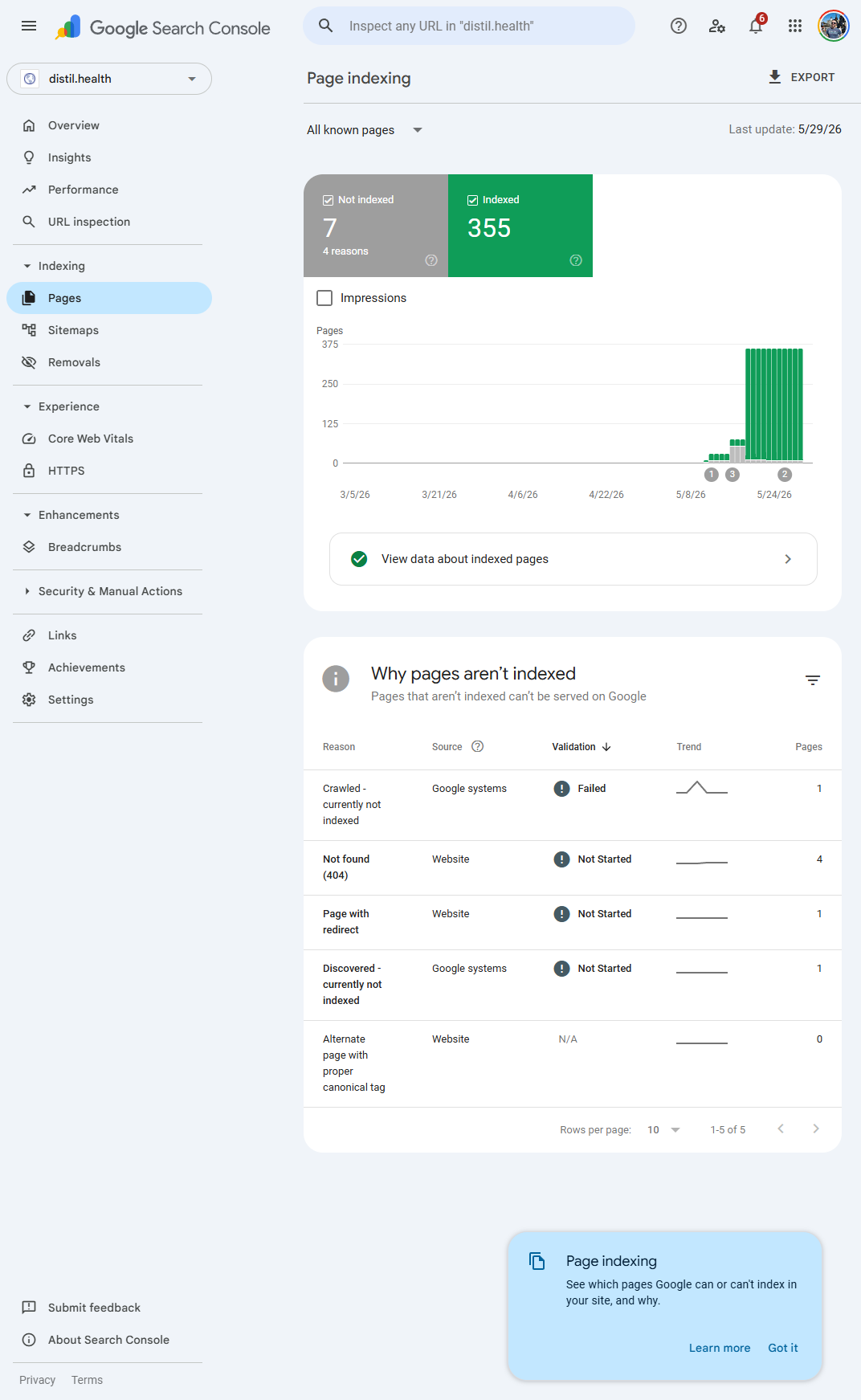
For most of the spring, Google had indexed 22 pages of our site. We had submitted 356 in the sitemap. So 6 percent of what we asked Google to look at, it had agreed to keep.
Eight days later that number was 354. Almost the whole sitemap. I want to write down what changed, because the real version is more useful than the headline, and because the headline ("1509 percent growth in a week") is the kind of number that sounds like a trick and wasn't.
It was four separate pieces of work, done weeks apart, that only paid off when the last one landed. None of them would have worked alone. That is the part worth understanding.
The thing Google was telling us.
If you build pages programmatically, you meet a specific verdict in Search Console: "Crawled, currently not indexed." It means Google came, read the page, and decided not to keep it. Not blocked. Not broken. Judged, and found not worth the index slot.
We had a lot of those. We had built 327 small pages, one per medication and one per supplement, each showing the interactions we had assessed for it. Useful pages, we thought. Google crawled them and mostly shrugged.
The reason is dull and important: a page that is structurally identical to 326 others, with only the drug name swapped, reads to Google as thin. The template is the tell. It does not matter that the underlying data is real and carefully sourced. If the visible prose is a fill-in-the-blank, the page looks like the thousand low-effort programmatic sites Google spent the last few years learning to filter out.
So the problem was never "Google hasn't found us." Google had found us in March. The problem was that it had looked and declined. Four things, together, changed the verdict.
One: build the pages at all.
The first step was the least clever and the most necessary. We built the 327 per-medication and per-supplement pages, each rendering the real assessed interactions for that drug or compound, each cross-linked to its partners, each with proper page titles, structured data, and a clean canonical URL.
This is the part most people stop at, and it is why most programmatic SEO underperforms. Building the pages gets you crawled. It does not get you indexed. We had the evidence for that sitting in our own dashboard for weeks: hundreds of pages crawled, 22 kept.
Two: give each page something only it could say.
The fix for thin content is not more pages. It is making each page worth keeping on its own.
So we hand-wrote a paragraph of clinical context for the highest-volume medications, and a class-level paragraph for the rest, so that the atorvastatin page talks about atorvastatin: that it is the most prescribed medicine in England, that most of the cholesterol drop happens at the lowest dose, that the supplement question that matters is additive muscle risk with high-dose niacin, not the rare interactions people worry about. The sertraline page talks about sertraline. The levothyroxine page talks about the four-hour separation from calcium and iron.
It is roughly 150 words per page, written from the same source material the rest of the site uses, condensed to plain language. It is the single least scalable thing we did, and it was the one that mattered most. The template stopped being the tell, because the prose was no longer interchangeable.
This is the move I would point any other builder at. The instinct with programmatic SEO is to scale the template. The thing that works is to make the template carry something un-templatable on every instance.
Three: link the long tail from pages Google already trusted.
A page with no internal links pointing at it is an orphan. Google finds it through the sitemap, but a sitemap entry is a weak signal: it says "this exists," not "this matters."
So we went to the pages Google did already trust, the methodology page and the founding essay, and added contextual links from them into the long tail. The methodology page went from zero outbound links into the per-drug pages to around twenty, each one in a sentence that earned it ("the top of that list is atorvastatin, then amlodipine, then the proton pump inhibitors"). The anchor pages started passing a little of their standing down into the pages that had none.
Four: tell Google you fixed it.
This is the step that is easy to miss, because it feels like it should be automatic. It is not.
When a page sits in "Crawled, currently not indexed," Google is not waiting eagerly to re-check it. It has moved on. You can wait for the next organic re-crawl, which can take many weeks, or you can use the "Validate Fix" button in Search Console, which is an explicit signal: I have changed these pages, please look again. We triggered it on 49 pages the day the new prose and the internal links went live.
That was the trigger that turned the other three pieces into a result. Within about a week the indexed count moved from 22 to 354, and sitemap coverage went from 6 percent to over 99. Impressions over the rolling window rose too, which is the leading edge of the same thing: more pages in the index means more queries the site can appear for.
The part that surprised me.
When we did the research on this in advance, the consistent finding was that a new, low-authority domain should expect four to eight weeks before this kind of work shows up in the lagging indicators. We planned for eight.
It landed in about three and a half. I do not think that is because we were unusually good. I think it is because the four pieces were genuinely complementary, and the Validate Fix signal collapsed the waiting. The pages were already crawled, so Google did not need to discover anything. It needed a reason to re-judge, and three reasons to keep what it re-judged. When all four were in place at once, the re-evaluation was fast.
What this is and isn't.
It is not a growth hack. Every step was weeks of unglamorous work, and the indexed count is a leading indicator, not revenue. Clicks are still the next thing to earn, and indexing is upstream of clicks, not the same as them.
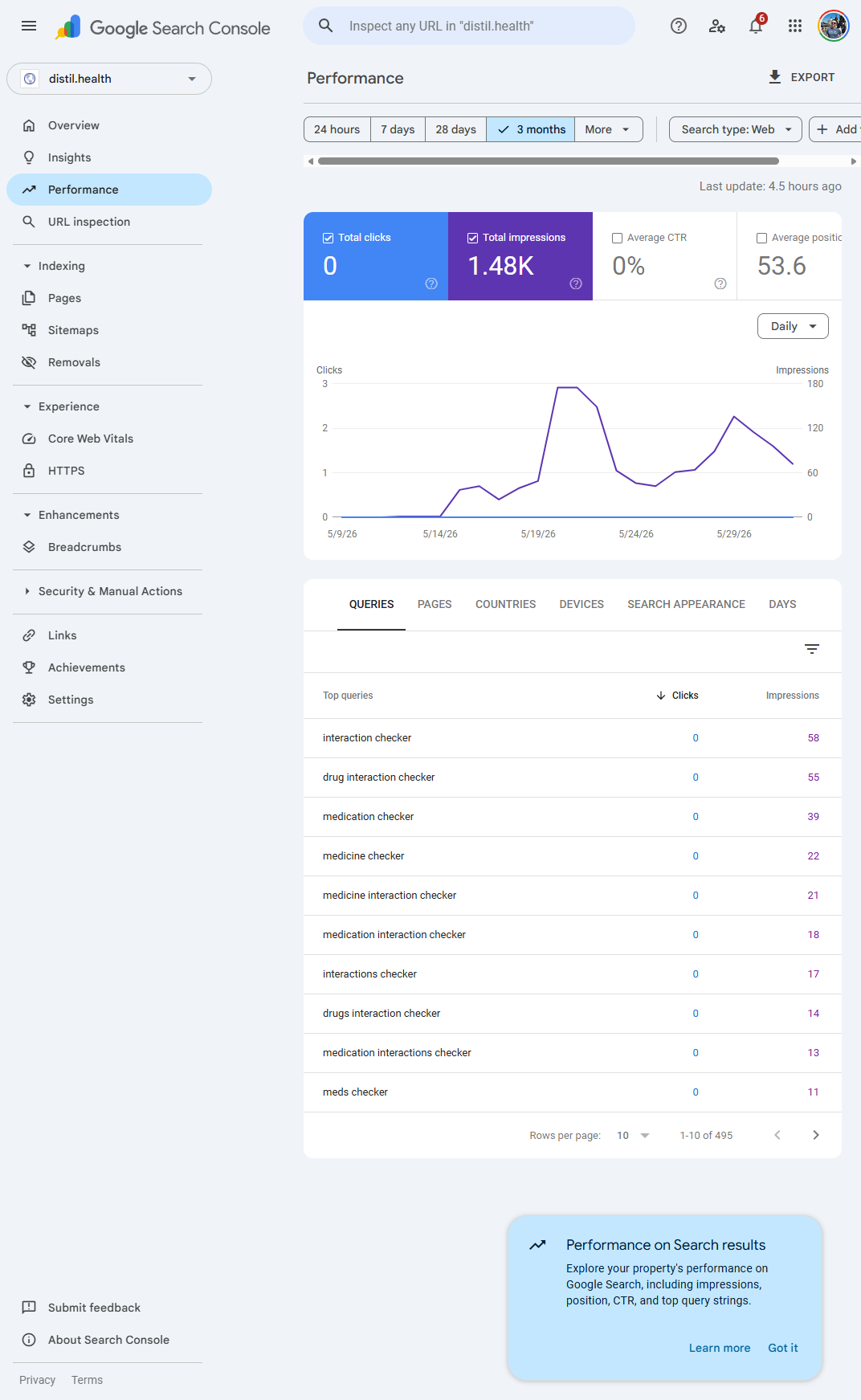
It has been a month since that week, and the honest update is split in two. The good half: the indexing held, and impressions kept climbing, past fourteen hundred over the rolling window. The sobering half: clicks are still zero. The pages are in the index and they surface for the right searches, terms like "drug interaction checker" and "medication checker," but they surface on page five, at an average position in the low fifties, where almost nobody clicks. That last gap is the one this recipe does not close. A clickable position is bought with domain authority and time, not with better pages, and on a young health domain that is the next, slower, harder piece of work.
But it is a clean four-part recipe, and each part has a measurable contribution: build the pages (gets you crawled), differentiate every one (gets you index-worthy), link them from pages that already rank (passes standing), and tell Google you have done it (prompts the re-check). Skip any one and the other three underperform, which is exactly what our own dashboard showed for the month we had only done the first.
If you are doing programmatic SEO and you are stuck at "Crawled, currently not indexed," it is almost certainly step two you are missing. That was us.
Building the pages gets you crawled. Differentiating every one gets you kept. Clicks come last, and they come slowly, so measure your patience as carefully as you measure your rankings.
/tools/interactions-checker: the free tool the 327 pages feed, every supplement-medication pair graded and cited.
/about/methodology: the rulebook behind the clinical context on each page.
/journal/why-i-built-distil: why a supplement report business doesn't sell supplements.
distil.health: get a report scored against your own profile.
The indexing, impression, position and click figures in this post are read directly from Distil's own Google Search Console (distil.health property, March to June 2026). The one clinical figure quoted as an example of the per-page prose:
- Oni-Orisan A, Hoffmann TJ, Ranatunga D, et al. Characterization of statin low-density lipoprotein cholesterol dose-response using electronic health records in a large population-based cohort. Circ Genom Precis Med 2018;11(9):e002043. PMID 30354326. Each doubling of statin dose lowers LDL-C by roughly a further 6 percent; most of the reduction occurs at the lowest approved dose.
Distil publishes long-form essays regularly. Methodology pieces, single-compound deep-dives, industry critique, and the occasional builder's field note like this one. No sales emails. Unsubscribe in one click.